
From 75 to 500 Employees: Building a Scalable Benefits Roadmap

Your benefits program that worked beautifully at 50 employees will start showing cracks around 75. By 150, those cracks become canyons. And somewhere between 250 and 500? You're either running a well-oiled machine or drowning in spreadsheets, vendor calls, and employee complaints about things nobody warned you would break.
Here's the uncomfortable truth: most growing companies don't have a benefits infrastructure problem at first. They have a benefits expectations problem. What employees expect from their benefits—and what your organization needs operationally—shifts dramatically as headcount scales. The companies that navigate this well aren't necessarily spending more money. They're planning ahead instead of reacting to each new crisis.
This guide maps out how benefits infrastructure needs evolve across four growth stages, introduces a governance model that prevents decision paralysis, and gives you a template roadmap you can adapt to your own timeline. No fear-mongering about what could go wrong. Just practical frameworks for building something that scales.
Why Benefits Infrastructure Breaks During Growth
Most benefits programs are built reactively. A startup picks a PEO because it's easy. A growing company adds a dental plan because employees asked. Someone implements an HRIS because the old spreadsheet finally caught fire (metaphorically, hopefully).
The problem isn't any single decision. It's that these decisions accumulate without a coherent architecture underneath them. By the time you hit 150 employees, you've got:
Three systems that don't talk to each other
A broker relationship that made sense five years ago but hasn't been reviewed since
Benefits decisions made by whoever happened to be in the room that day
No documented process for renewals, compliance, or employee communications
This isn't a failure of effort. It's a failure of infrastructure. Benefits, HR technology, payroll, and compliance aren't separate buckets—they're interconnected systems that either support each other or create friction [1].
The companies that scale smoothly treat benefits as infrastructure from the start. They build governance models, assign clear ownership, and plan for the next stage before they're drowning in the current one.
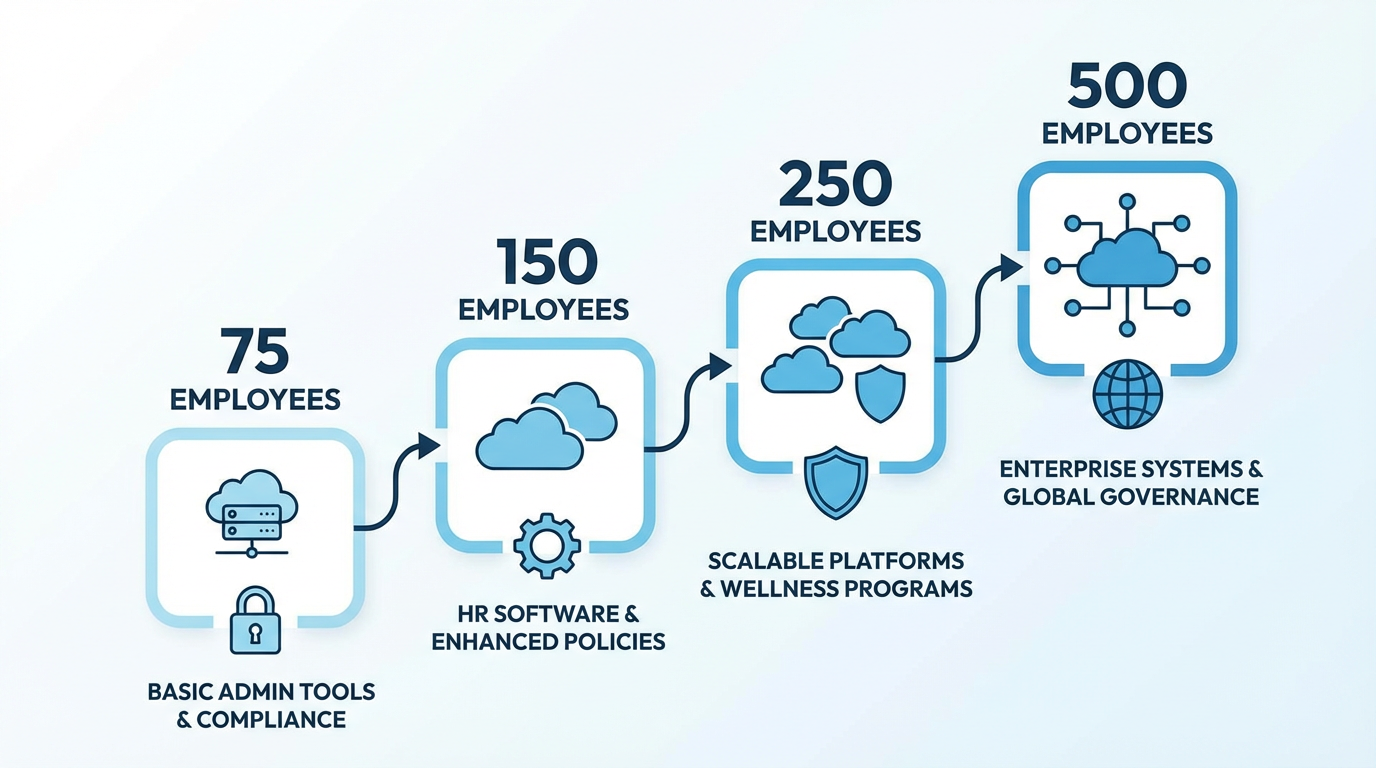
A scalable benefits roadmap maps infrastructure investments across company growth stages
Stage 1: 75 Employees—The First Real Complexity
At 75 employees, you're past the scrappy startup phase but not yet a mid-sized company. This is where benefits stop being "something HR handles" and start requiring actual strategy.
What Changes at This Stage
Employee expectations shift. Your early employees accepted whatever benefits you offered because they believed in the mission. New hires compare your package to competitors. They ask about HSA contribution limits, mental health coverage, and whether your 401(k) has a Roth option [2].
Compliance gets real. If you're approaching 50 full-time equivalent employees, you've already crossed into Applicable Large Employer territory under the ACA, meaning new reporting requirements and potential penalties for coverage gaps [2]. Multi-state employment—even a handful of remote workers—adds complexity fast.
The PEO question surfaces. Companies at this stage often wonder whether they've outgrown their PEO or whether they even need one anymore. There's no universal right answer here. Some organizations stay with a PEO well past 100 employees; others leave at 40. What matters is whether the model still serves your needs.
Infrastructure Needs
Key Questions to Answer
Who approves benefits changes, and what's the decision process?
When was the last time we evaluated whether our PEO or broker relationship still fits?
Do we know our total cost of benefits—not just premiums, but admin fees, PEO margins, and time spent managing it all?
Stage 2: 150 Employees—The Governance Inflection Point
Around 150 employees, something shifts. You can no longer run benefits on institutional knowledge and good intentions. If you haven't built governance structures yet, you'll feel the absence acutely.
What Changes at This Stage
Decision fatigue hits. More employees means more questions, more edge cases, and more competing priorities. Without clear governance, benefits decisions either stall indefinitely or get made by whoever shouts loudest.
Renewal season becomes chaos. At this size, you're likely seeing meaningful premium swings based on claims experience. Underwriting results land, leadership panics, and HR scrambles to make sense of it all in a compressed timeline [3]. Most of this panic is preventable with planning.
Specialization becomes necessary. The generalist HR person who handled everything can't keep up. You either need dedicated benefits expertise in-house or structured support from outside partners.
Infrastructure Needs
Governance Model Basics
A benefits governance model doesn't need to be complicated. At its core, it answers three questions:
Who decides what? Separate strategic decisions (plan design philosophy, budget allocation) from operational ones (vendor management, employee communications).
When do decisions happen? Build a calendar. Strategic decisions should happen well before renewal. Operational decisions should follow a predictable rhythm.
How do we escalate? Define what goes to leadership versus what gets handled by the benefits owner.
A simple structure might look like:
Strategic decisions (plan design, budget, PEO exit): Leadership team with HR input
Operational decisions (vendor selection within approved budget, communication strategy): Benefits owner or HR lead
Day-to-day administration (enrollment questions, claims escalation): HR team or outsourced support
The specific structure matters less than having any structure. Document it. Communicate it. Revisit it annually.
Stage 3: 250 Employees—Integration and Optimization
At 250 employees, you're firmly mid-market. The infrastructure decisions you made at 75 and 150 are either paying dividends or causing significant friction. This stage is about integration and optimization, not wholesale reinvention.
What Changes at This Stage
Data becomes valuable. You have enough employees to see meaningful patterns in claims, enrollment choices, and program utilization. Companies at this stage can make data-informed decisions about plan design—if they have systems that surface the right data [6].
Talent market pressure increases. You're competing for candidates with larger companies that have more established benefits programs. Benefits become a real differentiator in recruiting, not just a checkbox.
Complexity compounds. Multiple office locations, varying state requirements, perhaps international employees or contractors. Each layer adds administrative burden and compliance risk.
Infrastructure Needs
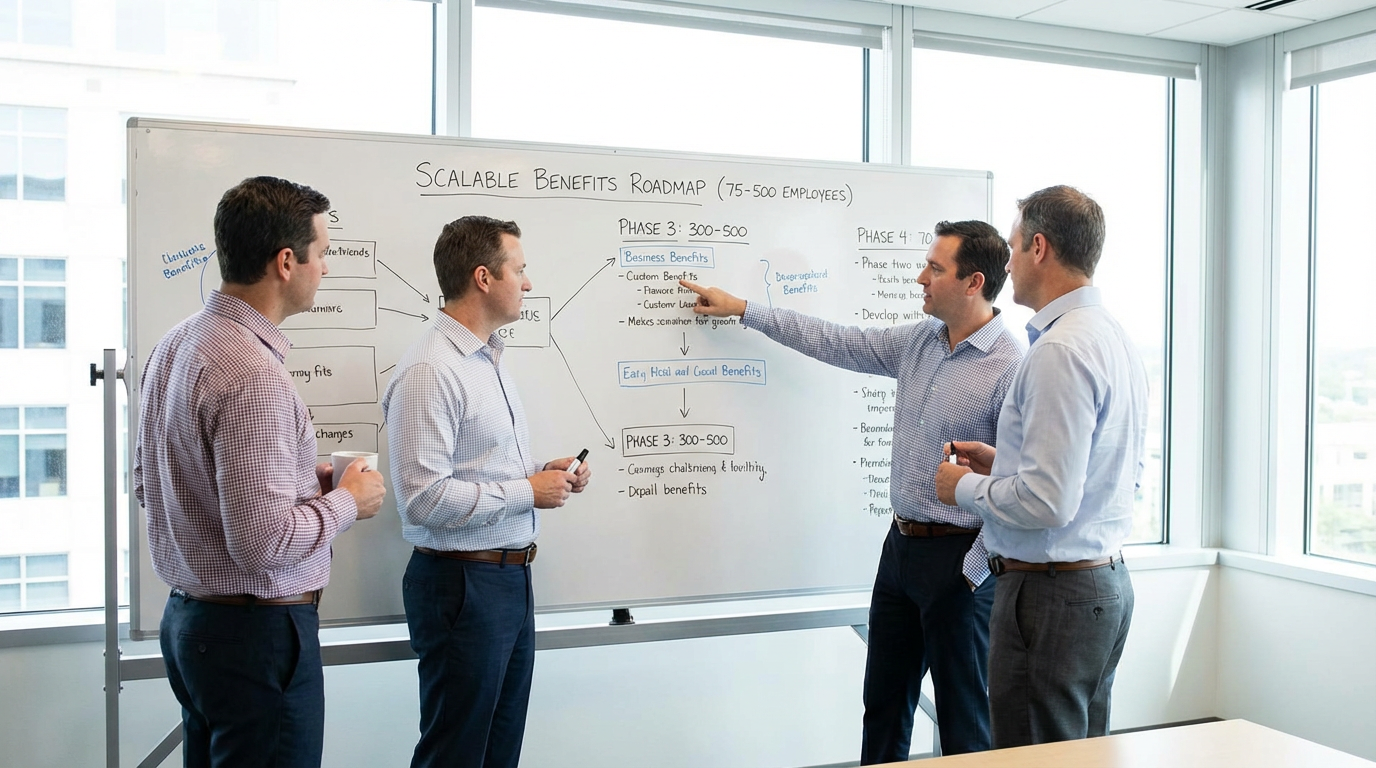
Integration Priorities
The biggest lever at this stage is integration. Fragmented systems create manual work, increase error rates, and make it nearly impossible to get a clear picture of total benefits spend.
Evaluate:
Does your HRIS feed data to your benefits administration platform automatically?
Can employees self-service enrollment, life event changes, and benefits questions?
Does your broker provide reporting that actually helps you make decisions, or just walls of carrier data?
If the answer to any of these is "no" or "sort of," you've got integration work to do. This isn't about buying more technology—sometimes it's about using what you have better or replacing systems that don't play well with others.
Stage 4: 500 Employees—Mature Infrastructure and Strategic Benefits
At 500 employees, your benefits program should be running on established processes, not heroic individual effort. If you're still putting out fires constantly, something in the infrastructure isn't working.
What Changes at This Stage
Benefits become strategic. At this scale, benefits spending is a significant line item. Leadership cares about ROI, retention impact, and how benefits support broader talent strategy.
Self-funding becomes viable. Many organizations at this size explore self-funded health plans for cost control and data ownership. This requires more sophisticated risk management and vendor relationships [4].
Organizational complexity is the norm. Multiple business units, acquisitions, different employee populations with different needs. The governance model needs to accommodate this complexity without becoming bureaucratic.
Infrastructure Needs
Governance at Scale
At 500 employees, governance typically involves multiple stakeholders:
Benefits committee: Cross-functional group (HR, Finance, possibly Legal) that owns strategic direction
HR operations: Manages day-to-day administration and vendor relationships
Executive sponsor: Ensures benefits strategy aligns with organizational priorities
Finance partnership: Budgeting, forecasting, and cost analysis
The committee structure prevents both autocratic decision-making and decision paralysis. Establish clear charters, meeting cadences, and escalation paths.
Mapping Your Growth to Infrastructure Investments
Here's a framework for thinking about when to invest in different infrastructure components:
This isn't a rigid prescription. Your timeline depends on growth rate, industry, geographic complexity, and current infrastructure state. A company that's been at 100 employees for five years has different needs than one that's grown from 50 to 100 in six months.
The Template Roadmap: A Framework You Can Steal
Below is a template benefits infrastructure roadmap. Adapt the timeframes and priorities to your situation.
12-Month Rolling Roadmap Template
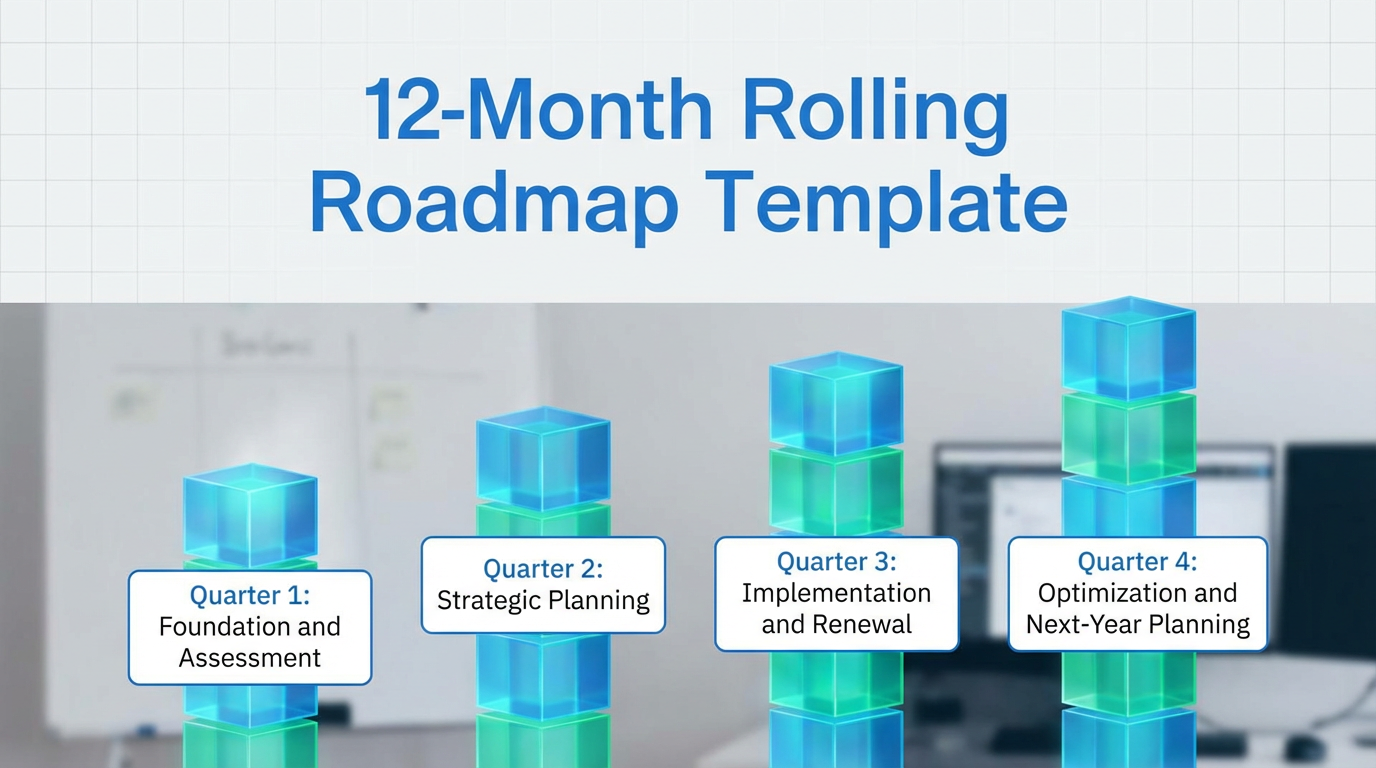
Quarter 1: Foundation and Assessment
Document current state: vendors, contracts, costs, pain points
Establish or clarify governance model (who decides what)
Identify top 3 infrastructure gaps
Build renewal calendar for upcoming year
Quarter 2: Strategic Planning
Define benefits philosophy if not documented
Evaluate major vendor relationships (broker, PEO, primary carriers)
Begin renewal preparation (if renewal falls in Q3/Q4)
Address highest-priority infrastructure gap
Quarter 3: Implementation and Renewal
Execute renewal process using structured timeline
Implement technology or process improvements identified in Q1
Employee communication planning for upcoming changes
Mid-year governance review
Quarter 4: Optimization and Next-Year Planning
Open enrollment execution
Post-enrollment audit and improvement identification
Compliance year-end tasks
Build next year's roadmap based on lessons learned
Annual Strategic Questions
Each year, your governance group should answer:
Is our current infrastructure model (PEO vs. direct, broker relationship, technology stack) still optimal for our size and trajectory?
What will break first as we grow over the next 12-24 months?
Are we meeting employee expectations? How do we know?
What's our total cost of benefits, including internal administration time?
What decisions did we defer this year that we need to address next year?
Document the answers. Revisit them quarterly. Adjust the roadmap as circumstances change.
Common Mistakes to Avoid at Each Stage
At 75 Employees
Assuming the PEO will handle everything forever
Not documenting who owns benefits decisions
Ignoring ACA and multi-state compliance requirements
At 150 Employees
Starting renewal conversations too late (inside of 90 days is too late)
Letting benefits decisions get made in hallway conversations
Treating technology as an afterthought
At 250 Employees
Having systems that don't integrate
Making plan design decisions without data
Neglecting vendor relationship management
At 500 Employees
Assuming current infrastructure will scale without investment
Delaying self-funding evaluation if it could provide value
Letting governance become bureaucratic rather than enabling
Planning Is the Antidote to Benefits Chaos
The companies that scale benefits well share one trait: they plan before they're forced to react. They know that what worked at 75 employees won't work at 150, and what worked at 150 won't work at 250.
Building a scalable benefits roadmap isn't about predicting the future perfectly. It's about creating structures—governance models, vendor relationships, technology systems, and review cycles—that adapt as your organization grows.
The template in this guide is a starting point. Your version will look different based on your industry, growth rate, and current infrastructure state. What matters is that you have a roadmap, not just a collection of point-in-time decisions.
Ready to Map Your Benefits Infrastructure?
If you're looking at the roadmap above and realizing there are gaps you're not sure how to fill—or you're questioning whether your current infrastructure still fits—that's a good sign you're thinking about this the right way.
Q Benefits Administration helps growing companies build benefits infrastructure that scales. We provide the expertise to help you make smarter decisions about your benefits, technology, and vendor relationships.
What's your Q? Request a consult to talk through your specific situation.
Frequently Asked Questions
When should a growing company consider leaving a PEO?
There's no universal headcount threshold for PEO exit. Companies successfully stay with PEOs at 200+ employees, while others leave at 50. The right time to evaluate is when you're experiencing friction—opaque costs, limited plan flexibility, or bundled services you don't need. An honest assessment of total costs and administrative burden should drive the decision, not emotions or one-off events.
What's the minimum governance structure a 100-person company needs?
At minimum, document three things: who has authority to approve benefits changes, what decisions require leadership involvement versus HR-level approval, and when strategic benefits discussions happen (not just renewal time). This can be a one-page document. The structure matters less than having explicit answers to these questions that everyone understands.
How far in advance should we start renewal planning?
Start strategic renewal work 5-6 months before your renewal date. This allows time to evaluate alternatives, negotiate effectively, and communicate changes to employees. If you're starting inside of 90 days, you're reactive rather than proactive, which limits your options and increases stress [3].
How do we know if our benefits infrastructure is ready for the next growth stage?
Ask yourself: What manual processes exist that will break if we add 50 more employees? What decisions are getting delayed because ownership is unclear? What data do we wish we had but can't easily access? If you have clear answers and plans to address them, you're in reasonable shape. If these questions surface problems you haven't thought about, you have infrastructure work to do.
Should we hire internal benefits expertise or use outside consultants?
It depends on your growth rate and complexity. Companies with stable headcount may do well with external support. Rapid growth, multi-state complexity, or significant M&A activity often justifies internal expertise sooner. Many organizations use a hybrid: internal coordination with external strategic support for major projects like vendor selection or PEO transitions.
Expert Perspective & Credentials

About Q Benefits Administration
Q Benefits Administration provides impartial, project-based benefits infrastructure consulting for mid-sized employers and growing startups. Founded by Cora Lynn Alvar, SHRM-CP, Q brings over a decade of experience in health and welfare benefits, HR technology, and mid-market consulting. We help HR, finance, and operations leaders navigate complex transitions—PEO exits, HRIS implementations, benefits strategy overhauls—with structured planning and vendor-agnostic advice. Our expertise spans plan design, technology selection, compliance, and the operational realities of making benefits programs work as companies scale.
Founder Expertise:
Q Benefits Administration was founded by Cora Lynn Alvar, SHRM-CP, who has over a decade of experience in health and welfare benefits consulting, retirement plan services, and HR infrastructure design for mid-market organizations. Prior to founding Q Benefits, Cora Lynn worked with large national brokerages managing complex benefits programs and benefits-technology transition projects for companies across multiple industries.
Why We Wrote This
This article synthesizes insights from our client engagements, industry research, and direct conversations with HR and finance leaders at dozens of mid-sized companies. We wrote it because we kept having the same conversation repeatedly: smart, capable leaders who knew something wasn't working with their PEO but weren't sure if they were just being difficult or if their concerns were valid. They needed a framework for evaluation that didn't come from someone trying to sell them something.
Our Perspective on PEOs
We're not anti-PEO. For companies under 50 employees, particularly fast-growing startups that need to focus on product and market fit rather than HR infrastructure, PEOs can be excellent solutions. But we've seen too many companies stay in PEO relationships past the point where they make strategic sense—simply because no one gave them permission to ask whether there was a better way.
Disclaimer
This article provides general educational information about PEO transitions and benefits infrastructure for small and mid-sized employers. It is not intended as legal, tax, accounting, or financial advice, and should not be relied upon as such.
Every company's situation is unique, and PEO contracts vary significantly in their terms, fees, and termination provisions. Before making any decisions about terminating or modifying a PEO relationship, consult with qualified legal, tax, and HR professionals who can assess your specific circumstances, review your actual contract terms, and advise on compliance obligations specific to your industry and jurisdictions.
The cost figures, timelines, and recommendations in this article are based on industry averages and Q Benefits Administration's client experience as of January 2026. Your actual costs and timelines may differ based on company size, location, industry, benefits complexity, and current market conditions.
Cited Works
[1] Q Benefits Administration — "About Q Benefits." https://qbenefitsadministration.com/about-1
[2] IRS — "Applicable Large Employer Information." https://www.irs.gov/affordable-care-act/employers/determining-if-an-employer-is-an-applicable-large-employer
[3] Q Benefits Administration — "Services." https://qbenefitsadministration.com/services
[4] Kaiser Family Foundation — "Employer Health Benefits Survey." https://www.kff.org/health-costs/report/employer-health-benefits-survey/
