
Auditing Your HR Tech Stack for Bias, Compliance, and Benefits Risk
Audio Overview
Let's play a quick game. Close your eyes and picture your HR tech stack. Now ask yourself: do you actually know what it's deciding?
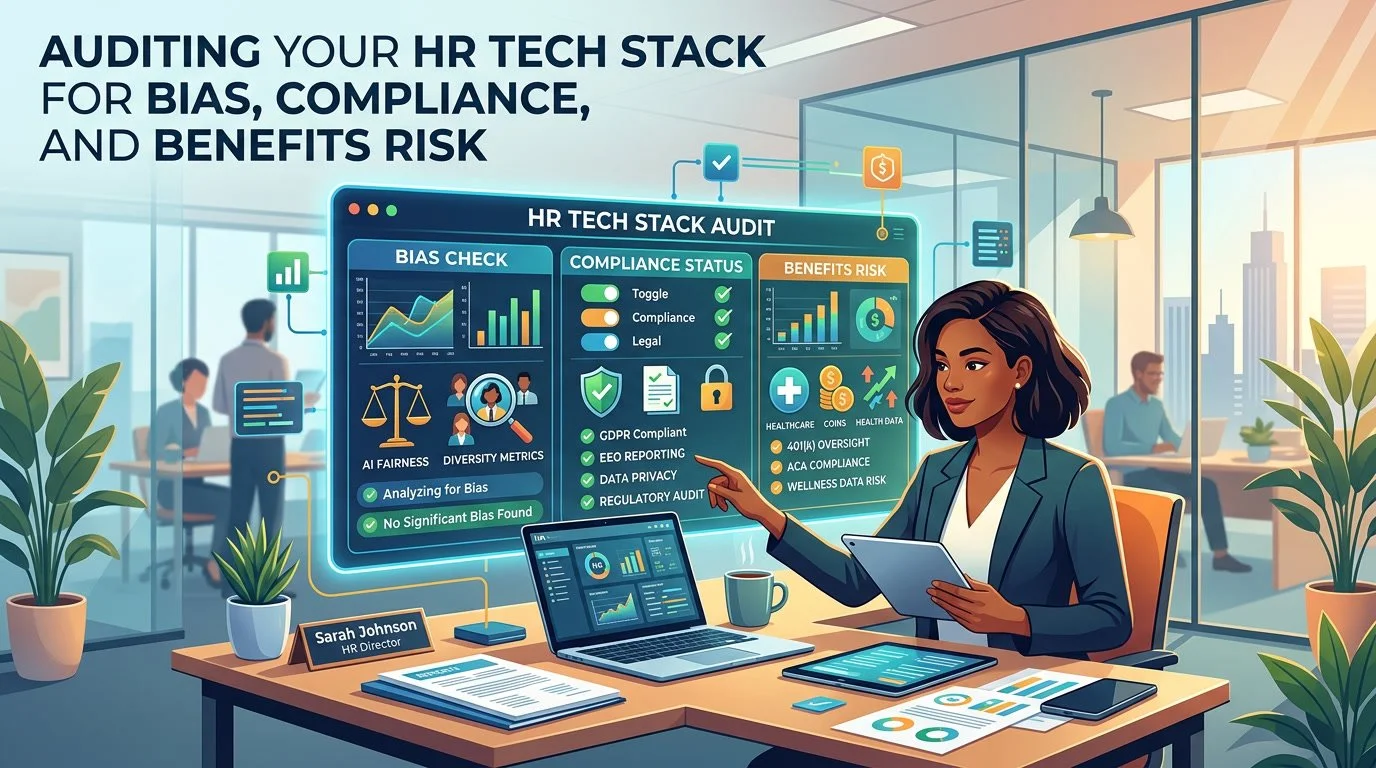
Because right now, while you're reading this, your HRIS, ATS, benefits administration platform, and payroll system are making calls about people. Which resumes bubble up, who gets flagged for a performance conversation, which benefits options employees see when they sit down to enroll, etc. These calls are happening inside algorithms you didn't build, didn't train, and — if we're being honest — probably haven't audited.
That's not a knock. Most mid-sized companies have layered HR tech over the years the way the rest of us layer leftovers in the fridge: one thing at a time, with good intentions, until one day you open the door and think, wait, what is all this? The difference is that a questionable casserole is just sad. A poorly integrated HR tech stack is a compliance exposure, a bias liability, and a benefits infrastructure problem rolled into one.
An HRIS bias compliance audit catches these issues before a regulator, a lawsuit, or an employee complaint forces the conversation. Here's how to run one.
Why HR Tech Audits Matter More Now Than Ever
The regulatory landscape around automated decision systems in employment is moving fast — and not in a "maybe someday" kind of way.
New York City's Local Law 144 already requires annual bias audits of automated employment decision tools used in hiring and promotion. A December 2025 state Comptroller's audit found enforcement had been minimal so far — but the NYC Department of Consumer and Worker Protection has committed to closing every identified gap, signaling a shift from "we'll get around to it" to "we're coming" [1].
At the federal level, the picture is messier. In January 2025, the EEOC pulled its AI-related guidance following an executive order directing agencies to deprioritize disparate impact enforcement. But the underlying statutes — Title VII, the ADA, the ADEA — are still very much on the books. And private litigation is stepping in wherever enforcement steps back. The Mobley v. Workday case puts a number on the stakes: in May 2025, a federal court certified a nationwide collective action alleging that Workday's AI screening system discriminated against applicants over 40. The court was clear that letting software off the hook would risk gutting anti-discrimination law [2].
Colorado's AI Act takes effect June 30, 2026, requiring documented governance programs and annual impact assessments for high-risk AI systems, with civil penalties up to $20,000 per violation [3]. Illinois and California aren't far behind.
As I mentioned on my site last year, the California Civil Rights department began to enforce an amendment to the Fair Employment and Housing Act (FEHA) addressing automated decision-systems (ADS), effective October 1, 2025. The onus is on employers and any agents (i.e. a recruiter or applicant tracking system embedded in a Human Capital Management system) to ensure the ADS is not making hiring decisions by discriminating against protected classes.
The tools themselves aren't the villain here. The problem is that most organizations adopted them without ever building the governance to manage the risks they create. Good intentions, meet unintended consequences.
Three Risk Categories to Audit
A solid HR tech audit covers three interconnected risk areas. Think of it like a three-legged stool — miss one leg and the whole thing tips.
Bias Risk
Algorithmic bias in HR tech loves a good hiding spot — and it often finds one in hiring tools and benefits administration. Resume screening algorithms trained on historical data can quietly perpetuate past discrimination patterns, even without explicitly using protected characteristics as a variable. On the benefits side, personalization algorithms may steer employees toward different plan options based on demographic proxies, and eligibility logic may apply rules inconsistently across employee populations. None of it is intentional. All of it is a problem.
Compliance Risk
Your HRIS and benefits platforms are sitting on a mountain of sensitive data: protected health information, personally identifiable information, and potentially biometric data — all subject to HIPAA, state privacy laws, and GDPR for any EU employees [4]. Layer in benefits compliance under ERISA, the ACA, COBRA, and Section 125 cafeteria plan rules, plus I-9 verification, ban-the-box requirements, and pay equity obligations, and you've got a compliance checklist that doesn't forgive gaps.
Benefits Infrastructure Risk
This is where most audits drop the ball. The data flowing between your HRIS, payroll, benefits administration platform, and carriers is what actually determines who gets enrolled, when, in what plans, and at what cost. When integrations fail, real people get hurt: employees who believe they're covered but aren't, retroactive premium corrections that hit out of nowhere, COBRA notices that go out late and leave the company liable. These aren't horror stories from a textbook — they're what surfaces regularly when companies untangle HR tech decisions that were never made with the full picture in mind.
The HR Tech Audit Framework
Step 1: Inventory Your Stack and Data Flows
Most mid-sized companies can’t produce a complete inventory of their HR tech tools, integrations, and data flows on demand. Before you can audit anything, document every system that touches employee data, how data moves between systems, where it’s stored and who can access it, which vendors touch which data, and how long each system retains records.
Step 2: Review Vendor Contracts for Risk Allocation
Your vendor contracts are your first line of defense—or your biggest exposure. Key provisions to examine:
If your vendor uses AI for screening or recommendations, ask specifically whether they’ve conducted bias audits and request the documentation. Vendors who can’t or won’t provide it are a risk worth escalating.
Step 3: Assess Algorithmic Decision Points
Identify every place in your stack where an algorithm influences a decision about a person. For each, ask what data inputs it uses, what outcomes it optimizes for, whether the vendor has conducted disparate impact testing, whether decisions can be explained to a regulator, and whether human reviewers can override recommendations. Watch for red flags: a vendor claiming their AI is “bias-free” without sharing training data demographics, recommendations that can’t be overridden, or documentation that’s all marketing and no technical substance.
Step 4: Test Benefits Administration Logic
Benefits platforms apply eligibility rules, calculate contributions, and manage life event changes. Errors create ERISA compliance issues, ACA reporting problems, or unfair outcomes. Pull a sample of employees across different classifications and verify that eligibility, contributions, and life event processing all match your plan documents—not the vendor’s default configuration.
Where silent errors hide: An employee’s status change flows correctly to payroll but fails to trigger a benefits eligibility update. Payroll deducts premiums, but the carrier never gets the enrollment file. Months later, a claim is denied—and you’re explaining to an employee why coverage they paid for doesn’t exist.
Step 5: Evaluate Integration Health
Trace a sample of employee records through the full data flow—HRIS to benefits admin to carriers. Look for new hire records that don’t trigger enrollment windows, termination dates that don’t reach carriers in time for COBRA, and payroll deductions that don’t match elections. Discrepancies reveal the process gaps that audits are designed to catch.
Building Ongoing Governance
A one-time audit diagnoses the current state. Governance is how you prevent the next mess.
Establish clear ownership. In most mid-sized companies, HR tech decisions happen piecemeal—HR picks the ATS, IT picks the HRIS, finance weighs in on payroll, and nobody examines the full stack. A governance framework should clarify who approves purchases, who reviews vendor contracts, who monitors integrations, and how often comprehensive audits occur.
Require vendor transparency. Make it a condition of doing business. Ask what algorithmic features the product includes, what data they use, and what bias testing has been conducted. The regulatory direction—across NYC, Colorado, California, and the EU—is toward more disclosure, not less.
Connect HR tech decisions to benefits strategy. Your tech stack isn’t just an operational convenience. It’s the infrastructure that delivers your benefits program. Choices about HRIS, benefits administration, and vendor relationships directly affect whether employees get the coverage you promised and whether your benefits investment achieves your talent strategy goals. That’s why we treat HR tech decisions as part of benefits infrastructure—not a separate conversation.
When to Bring in Outside Help
Not every organization needs an external audit, but outside expertise pays for itself when:

You’re transitioning off a PEO and need to stand up your own stack without inheriting integration problems
You’re selecting a new HRIS or benefits platform and want governance built in from the start
You’ve never audited your stack and lack internal expertise in bias testing or benefits compliance
A vendor is asking you to sign a contract with terms you don’t fully understand
Q Benefits helps organizations audit their HR tech and benefits infrastructure, build governance frameworks, and negotiate vendor contracts that protect the client—not the vendor.
Frequently Asked Questions
Who is liable if our HR software discriminates—us or the vendor?
In most cases, the employer bears primary liability—even when discrimination results from a vendor’s algorithm. Courts are also allowing claims against AI vendors as “agents” of employers, as Mobley v. Workday demonstrates [2]. Indemnification clauses can shift some risk, but they must be negotiated explicitly.
How often should we audit our HR tech stack?
Annual comprehensive audits are a reasonable baseline. Conduct targeted reviews whenever you implement new systems, change vendors, or expand into new jurisdictions. Integration health deserves continuous monitoring.
Can we do this internally?
Yes, if you have combined expertise in HR technology, data privacy, employment law, and benefits compliance. Most mid-sized companies lack that combination in one team. External help adds particular value for contract review, bias testing methodology, and benefits infrastructure evaluation.
Take the Next Step
The question isn’t whether to audit—it’s whether to do it now, on your terms, or later, on a regulator’s timeline.
What’s your Q? Request a consult and let’s talk through what an audit would look like for your organization.

About Q Benefits Administration
Q Benefits Administration is a benefits infrastructure consulting firm founded by Cora Lynn Alvar (SHRM-CP), a licensed Life & Health insurance agent with over a decade of experience in mid-market benefits strategy. Q helps HR, finance, and operations leaders navigate complex benefits decisions, HR technology selection, and high-stakes transitions like PEO exits.
This article is for informational purposes only and does not constitute legal, tax, or investment advice. Consult qualified legal counsel for guidance specific to your organization’s regulatory obligations.
Cited Works
[1] NYS Office of the Comptroller — “Enforcement of Local Law 144 – Automated Employment Decision Tools.” https://www.osc.ny.gov/state-agencies/audits/2025/12/02/enforcement-local-law-144-automated-employment-decision-tools. Published: 2025-12-02. Accessed: 2026-02-26.
[2] Fisher Phillips — “Discrimination Lawsuit Over Workday’s AI Hiring Tools Can Proceed as Class Action.” https://www.fisherphillips.com/en/news-insights/discrimination-lawsuit-over-workdays-ai-hiring-tools-can-proceed-as-class-action-6-things.html. Published: 2025-05-19. Accessed: 2026-02-26.
[3] Rocky Mountain Employer — “New AI Compliance Requirements Prohibit Discrimination for Colorado Employers.” https://www.rockymountainemployersblog.com/blog/2025/12/5/new-ai-compliance-requirements-prohibit-discrimination-for-colorado-employers. Published: 2025-12-05. Accessed: 2026-02-26.
[4] U.S. Department of Health and Human Services — “Summary of the HIPAA Privacy Rule.” https://www.hhs.gov/hipaa/for-professionals/privacy/laws-regulations/index.html. Accessed: 2026-02-26.
