
How to Run a Broker RFP (Without Making Everyone Hate You)

Running a broker RFP sits comfortably between "annual performance reviews" and "explaining why the printer jammed again" on the list of things HR leaders actively avoid. The process tends to devolve into awkward conversations, sprawling spreadsheets, and the distinct sensation that you've somehow offended everyone involved—including your current broker, the new candidates, and possibly yourself.
A well-run broker RFP doesn't have to unfold this way. Done thoughtfully, it's one of the most powerful tools for ensuring your benefits program receives the strategic attention it deserves. The secret isn't just asking for quotes. It's understanding the difference between shopping and stewardship—and structuring a process that respects everyone's time while delivering real answers.
Why Most Broker RFPs Go Sideways
The typical broker RFP fails for predictable reasons. Companies either turn it into a pure price hunt (which attracts transactional brokers who disappear after enrollment) or they skip the process entirely because "it seems mean" to evaluate alternatives. Neither approach serves your employees or your organization.
A broker relationship isn't a commodity purchase. You're selecting a strategic partner who'll influence your benefits infrastructure, employee experience, and potentially millions of dollars in spend over several years [1]. According to recent employer health benefits data, the average annual premium for employer-sponsored family coverage now exceeds $23,000, with employers covering roughly 73% of that cost [2]. That level of spend deserves more rigor than picking the lowest bidder—and more transparency than hoping your current broker magically improves.
The goal isn't to make anyone hate you. It's to make an informed decision with clear criteria, honest communication, and a process that treats all parties like professionals.
Shopping vs. Stewardship: Know What You Actually Need
Before you draft a single RFP question, get clear on what you're really evaluating.
Shopping is about finding a new broker because something is broken: poor service, missed deadlines, lack of strategic guidance, or a relationship that's gone stale. You're actively looking to make a change.
Stewardship is about validating your current relationship and ensuring you're receiving market-competitive service and fees. You might be perfectly happy but want confirmation—or you want to give your incumbent broker the opportunity to level up before you consider alternatives.
These two scenarios require different approaches:
Being honest with yourself about which mode you're in prevents the awkward dance where everyone pretends you're "just exploring" when you've already decided your broker needs to go.
The Timeline That Prevents November Panic
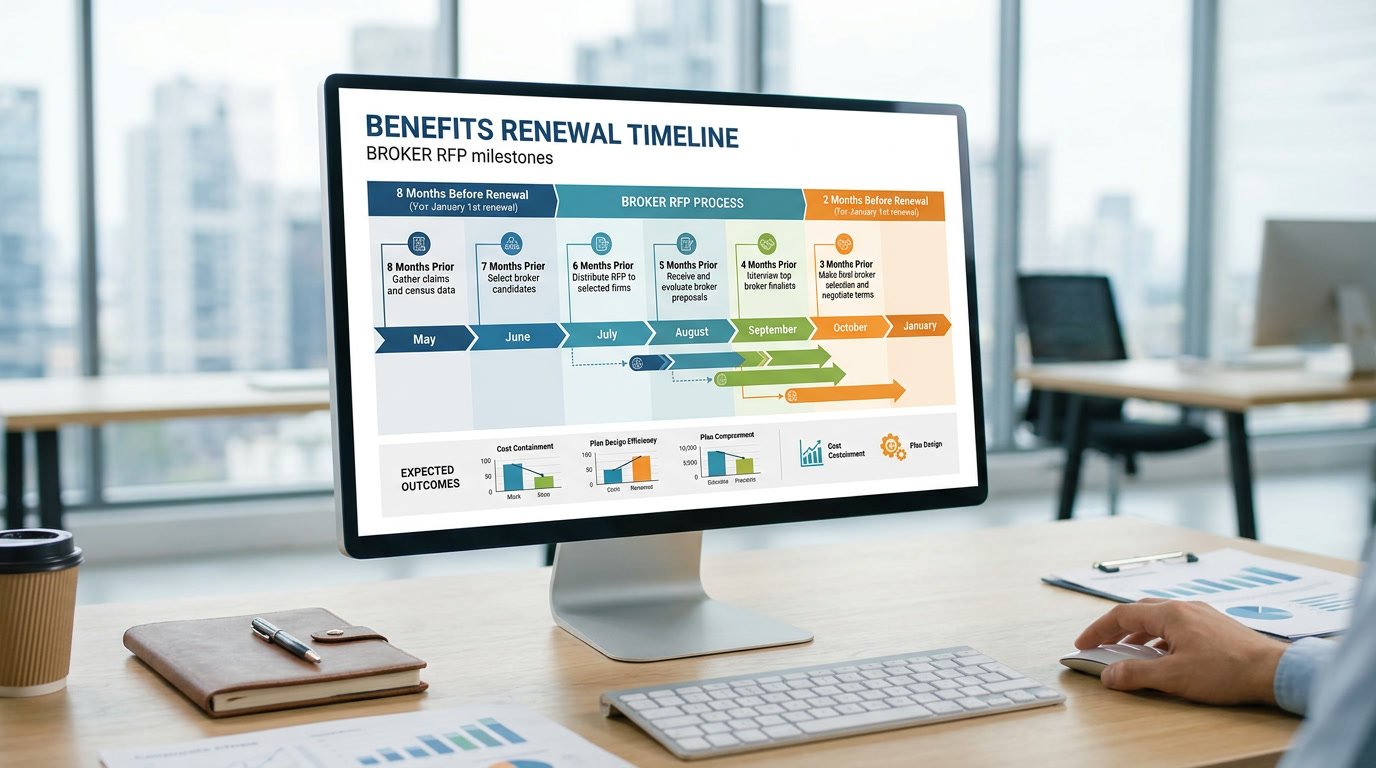
Start your broker RFP 6-8 months before renewal to avoid rushed decisions
Rushing a broker RFP is how you end up making panicked decisions when you should be finalizing enrollment materials. A realistic timeline builds in breathing room:
6–8 Months Before Renewal
Internal alignment: confirm stakeholders, budget considerations, and decision criteria
Finalize RFP document and candidate list
5–6 Months Before Renewal
Issue RFP to selected candidates (3–5 is manageable; more than 6 creates chaos)
Allow 2–3 weeks for responses
4–5 Months Before Renewal
Review written responses and score against criteria
Select finalists for presentations (typically 2–3)
3–4 Months Before Renewal
Conduct finalist presentations
Complete reference checks and final evaluation
Make selection and notify all candidates
2–3 Months Before Renewal
Transition planning with new broker (if changing)
Or formalize renewed commitment with incumbent
Starting earlier gives you options. Starting later gives you stress.
How to Issue the RFP: Format and Distribution
The mechanics of issuing your RFP matter more than most organizations realize. A disorganized distribution process signals to brokers that your evaluation will be equally chaotic—and top-tier firms may deprioritize their response accordingly.
Choosing Your Format
Word Document: Works well for narrative-heavy RFPs where you want brokers to describe their approach in detail. Easier to customize but harder to compare responses side-by-side.
Excel Spreadsheet: Ideal for standardized questions and quantitative comparisons. Creates natural consistency across responses and simplifies scoring. Consider using separate tabs for different sections (company overview, service model, fees, references).
RFP Software Platforms: Tools like RFP360, Responsive (formerly RFPIO), or even survey platforms like Typeform can streamline collection and scoring for larger organizations. The investment makes sense if you're running multiple RFPs annually or need audit trails.
Hybrid Approach: Many organizations use Excel for structured questions and scoring while requesting a supplementary PDF or Word document for case studies and team bios.
Distribution Best Practices
Send the RFP simultaneously to all candidates (staggered distribution creates fairness concerns)
Include a cover letter explaining your timeline, evaluation process, and key contact
Specify a deadline for clarifying questions (typically one week after distribution)
Compile all clarifying questions and answers into a single document shared with all candidates
Set a firm submission deadline and stick to it
What to Disclose to Brokers (And What to Keep Close)
Transparency builds trust, but oversharing can undermine the process. Calibrating your disclosures appropriately:
Disclose Freely
Current plan designs and contribution strategies
Census data (anonymized appropriately)
Renewal history and recent rate changes
Known pain points with current broker relationship (if relevant)
Your evaluation timeline and decision process
Who will be involved in the decision
Disclose Selectively
Specific budget targets (share ranges, not exact numbers)
Current broker fees (share after proposals received, for comparison)
Names of other candidates in the RFP (optional—some prefer confidentiality)
Keep to Yourself
Internal politics or interpersonal conflicts
Complaints about specific broker team members by name
Predetermined preferences that would bias the process
Information shared in confidence by other candidates
One note on incumbent brokers: if you're in stewardship mode, tell them you're running a process and give them the same RFP as everyone else. Surprising a long-term partner with a competitive bid they didn't know was coming is an excellent way to damage a relationship you might want to keep.
The RFP Questions That Actually Tell You Something
Most broker RFPs ask predictable questions and receive predictable answers. "Tell us about your company" generates marketing brochures. "How will you provide excellent service" generates promises. Neither helps you differentiate.
Questions Worth Asking

Reference checks are the broker RFP step most companies skip but shouldn't
Team & Service Model
Who specifically will be assigned to our account? (Names, roles, experience)
What is that team's current book of business, and how do you prevent overload?
How do you handle team member transitions—what's your succession plan?
Strategic Approach
Walk us through how you'd approach our first 90 days as a new client
Describe a time you recommended a client not make a change they were considering. What happened?
How do you measure success for a client relationship beyond retention?
Market Access & Carrier Relationships
What carriers do you have the strongest relationships with, and why?
How do you handle situations where your recommended carrier isn't the cheapest option?
What's your process for negotiating beyond initial quoted rates?
Technology & Benefits Administration
What benefits administration platforms do you support, partner with, or have certified expertise in?
How do you handle data integrations between carriers, payroll systems, and HRIS platforms?
What enrollment technology do you provide or recommend, and what's included versus additional cost?
How do you support clients evaluating or transitioning HR technology during a broker change?
Communication & Responsiveness
What's your standard response time for routine questions? For urgent issues?
How do you prefer to communicate with clients (and how flexible are you)?
Show us an example of a benefits communication piece you created for a similar client
Compliance & Risk Management
How do you stay current on regulatory changes, and how do you communicate updates to clients?
What compliance resources do you provide, and what do you consider out of scope?
Fees & Compensation
Provide a complete breakdown of your compensation structure
What services are included in your standard fee, and what incurs additional charges?
Are you willing to work on a fee-for-service basis rather than commission?
Questions to Skip
"Why should we choose you?" (Everyone has a rehearsed answer)
"What makes you different?" (Generates generic differentiation claims)
"Can you save us money?" (The only honest answer is "it depends")
Building a Scoring Matrix That Doesn't Lie to You
Subjective gut feelings work fine for choosing restaurants. For broker selection, you need a framework that forces clarity and supports defensible decisions.
Sample Scoring Categories
Scoring Tips
Use a consistent scale (1–5 works well) with defined criteria for each score
Have multiple stakeholders score independently before discussing
Document specific examples that support each score
Weight "fit" appropriately—a technically superior broker who doesn't mesh with your team will underperform
Create your matrix before you receive proposals. Adjusting criteria after you've seen responses is how bias sneaks in.
The Presentation: What to Watch For

Broker RFP presentations reveal how firms actually operate beyond written proposals
Written responses tell you what brokers want you to know. Presentations reveal how they actually operate.
Green Flags
They ask clarifying questions about your specific situation
They acknowledge limitations or areas where they're still building expertise
They bring the actual team members who would work with you
They listen more than they pitch
They can explain complex concepts without jargon
Yellow Flags
Heavy focus on their firm's size, awards, or history
Vague answers about who specifically handles your account
Promises that sound too good ("We guarantee savings")
Inability to provide references from similar organizations
Red Flags
They brought the sales team, but the service team is "unavailable"
Defensive responses to straightforward questions
Disparaging comments about competitors or your current broker
Unwillingness to discuss compensation structure in detail
Reference Checks: The Step Everyone Skips
Ask every finalist for 3–5 client references—and actually call them. Most companies skip this step, which is remarkable given how much time they've already invested.
Questions for references:
How responsive is the team when you have urgent issues?
Has the team changed since you started working together, and how was that handled?
What's one thing you wish they did differently?
Would you choose them again? Why or why not?
Pay attention to hesitation, qualified praise, and what references don't say as much as what they do.
Breaking the News (Without Burning Bridges)
Telling candidates they didn't win is uncomfortable. Ghosting them is worse—and the benefits industry is smaller than you think.
For unsuccessful candidates:
Notify them promptly after your decision
Thank them genuinely for their time and effort
Offer brief, honest feedback if they ask (you don't owe a detailed debrief)
Leave the door open for future opportunities
For your incumbent (if not selected):
Have a direct conversation—don't deliver the news via email
Be clear about the timeline for transition
Acknowledge the relationship professionally
Expect some disappointment, and don't get defensive
For your new broker:
Confirm the decision in writing with clear next steps
Establish transition timeline and responsibilities
Introduce them to key stakeholders promptly
When the RFP Tells You to Stay Put
Sometimes the RFP process confirms what you suspected: your current broker is actually doing a solid job, and the grass isn't greener elsewhere. That's a valuable outcome, not a failed process.
Use this as an opportunity to:
Share (selectively) what you learned from the market
Discuss any service enhancements you'd like to see
Formalize expectations that may have been implicit
Renegotiate fees if market data supports it
A broker who knows you've done your homework and chosen to stay tends to bring renewed energy to the relationship.
Ready to Run Your RFP?
A broker RFP doesn't have to be adversarial, awkward, or exhausting. With clear criteria, honest communication, and a structured timeline, you can find the right partner for your benefits infrastructure—whether that's a new relationship or a renewed commitment to your current one.
If you're wrestling with whether it's time for an RFP, how to structure the process, or what questions will actually differentiate candidates, Q can help you map out your approach. Sometimes an outside perspective is exactly what you need to run a process that serves your organization—without making everyone hate you.
What's your Q?
Frequently Asked Questions
How often should we run a broker RFP?
Most organizations benefit from a formal broker evaluation every 3–5 years, even when satisfied with current service. This cadence ensures you're receiving market-competitive fees and strategic value. Running a stewardship-focused process validates your relationship without necessarily intending to change—and gives your incumbent broker useful feedback about market expectations.
Can we include our current broker in the RFP?
Absolutely—and in most cases, you should. Excluding your incumbent creates awkwardness and prevents direct comparison. Inform them early that you're running a process, provide the same RFP and timeline as other candidates, and evaluate them on equal footing. Many incumbents perform better when they know they're competing.
What if brokers ask who else is participating?
You're not obligated to share this information. A simple response like "We're evaluating several qualified firms" is sufficient. Some organizations prefer full transparency; others keep the candidate list confidential. Either approach is acceptable—just be consistent with all participants.
How do we handle fee negotiations after selecting a finalist?
Negotiate before you make a final commitment, not after. If fee structure is a concern, address it during finalist discussions rather than surprising your selected broker after they've celebrated winning. Be direct about budget constraints and ask what flexibility exists—most brokers expect some negotiation.
Should we hire a consultant to run the RFP for us?
External support makes sense when internal bandwidth is limited, you want a neutral third party managing the process, or you lack recent experience evaluating brokers. A consultant can also provide market benchmarking data and help you avoid common pitfalls. The investment typically pays for itself through better process design and more confident decisions.

About Q Benefits Administration
Q Benefits Administration brings over a decade of experience in health and welfare benefits, mid-market consulting, and benefits infrastructure strategy. Founded by Cora Lynn Alvar (SHRM-CP), Q has guided organizations through broker evaluations, PEO transitions, and complex benefits decisions where getting it right matters. Our project-based approach delivers actionable frameworks—like employee benefits broker RFP processes that actually work—without replacing your internal team. When implementation includes policy placement, QBA Insurance Solutions provides transparent options while keeping your organization's interests first.
Cited Works
[1] Society for Human Resource Management — "Selecting and Working with a Benefits Broker." https://www.shrm.org/topics-tools/tools/toolkits/selecting-working-benefits-broker
[2] Kaiser Family Foundation — "2023 Employer Health Benefits Survey." https://www.kff.org/health-costs/report/2023-employer-health-benefits-survey/
